At a time when global economies are navigating uncertainty, climate pressure, and shifting investment priorities, one force is redefining growth at scale: sustainability.
What was once considered a compliance requirement or corporate responsibility has rapidly evolved into a core investment strategy, shaping how capital is deployed, how industries operate, and how economies compete.
According to the United Nations, the global market for sustainable finance continues to expand, with sustainable bond issuance surpassing $1 trillion in 2024 alone, reflecting strong investor appetite for climate aligned assets. This acceleration signals a structural shift; one where sustainability is not just influencing markets, but actively driving them.
A Global Shift Toward Purpose Driven Investment
Governments, institutional investors, and private capital are increasingly aligning with environmental, social, and governance (ESG) frameworks. This alignment is not only a response to regulatory expectations but also a strategic move to unlock resilience and profitability in a rapidly evolving global market.
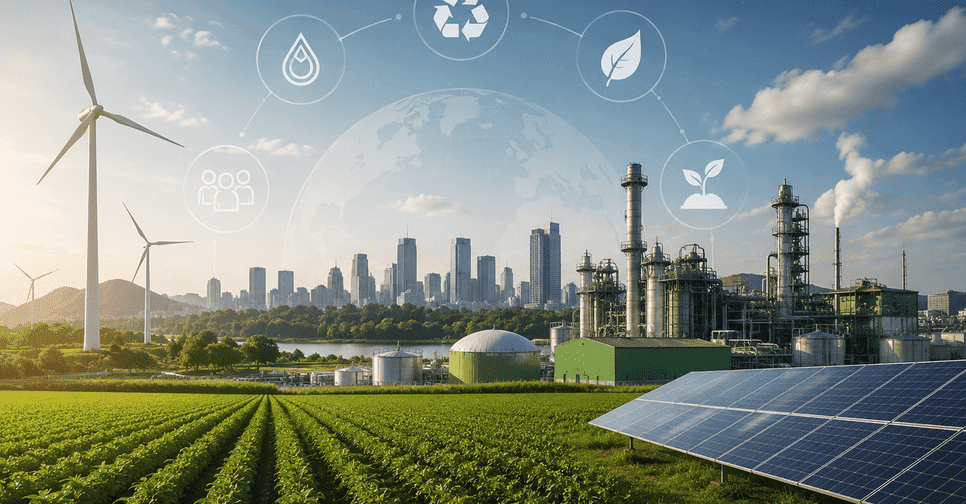
Sustainability driven investments are accelerating the transition toward clean energy systems, climate smart agriculture, and low impact industrial processes all of which are critical to meeting long term development goals while maintaining economic competitiveness.
Energy: The Transformation Powering Economic Growth
The transition to clean energy is gaining unprecedented momentum, supported by policy frameworks, technological innovation, and rising investment flows. Renewable energy capacity worldwide has crossed critical thresholds, while clean energy investment reached over $2 trillion globally in 2025, highlighting the scale and urgency of the transition.
At the same time, global commitments are intensifying. International agreements are pushing to triple renewable energy capacity by 2030, underlining the central role of clean energy in economic planning.
This shift is not only about reducing emissions; it is about building resilient, cost efficient, and future ready energy systems that can sustain long term economic growth.
Agriculture: Scaling Sustainability for Food Security
Agriculture, one of the world’s most essential sectors, is also undergoing transformation.
Today’s agrifood systems are both a major contributor to and a solution for global sustainability challenges. According to the Food and Agriculture Organization (FAO), food systems account for around 30% of global energy consumption and 31% of greenhouse gas emissions.
In response, investment is accelerating in precision farming, renewable powered irrigation, and climate smart technologies. These innovations are helping farmers increase yield efficiency, reduce resource consumption, and mitigate environmental impact.
From AI driven crop monitoring to advanced supply chain optimization, agriculture is becoming increasingly data driven and investment ready, offering scalable opportunities for investors seeking both impact and returns.
Industry: Redefining Production for a Sustainable Era
Industrial sectors are also being reshaped by sustainability. Manufacturing and industry remain key drivers of global economic output, but they are also among the largest contributors to emissions. According to UN data, global CO₂ emissions from fuel combustion and industrial processes reached 37.6 billion metric tons in recent years, reflecting the scale of the challenge.
At the same time, the response is accelerating and industries worldwide are investing in energy-efficient systems, circular manufacturing models, and sustainable materials, supported by digital technologies such as AI and automation. These innovations are helping companies reduce waste, improve productivity, and lower operational costs.
From ESG to Economic Strategy
The convergence of sustainability and investment marks a broader transformation in global markets. Sustainable investment products have grown into a multi trillion dollar ecosystem, with total sustainable fund assets reaching over $3 trillion globally, according to UN backed insights.
This capital is being directed into sectors that support long term resilience, energy transition, food security, infrastructure, and sustainable manufacturing redefining how growth is measured and achieved.
The United Nations notes that many Sustainable Development Goals are still off track, underscoring the need for increased collaboration, innovation, and investment.
AIM Congress: Advancing the Global Investment Agenda
In this evolving landscape, AIM Congress plays a critical role as a global platform that connects governments, investors, and industry leaders to explore the future of investment. By focusing on key pillars including foreign direct investment (FDI), global trade, startups, future cities, and sustainable development. The event serves as a catalyst for dialogue on how investment can drive inclusive, resilient, and long term economic growth.
By bringing together global stakeholders, AIM Congress provides a unique environment to exchange insights, forge strategic partnerships, and explore high impact investment opportunities across sectors undergoing transformation.
Investing with Purpose
As sustainability continues to reshape industries, the question is no longer whether to invest responsibly but how to do so effectively. The future will be defined by investments that balance profitability with impact, and innovation with long term resilience.
Join the Conversation and be part of the global dialogue shaping the future of sustainable investment at AIM Congress.