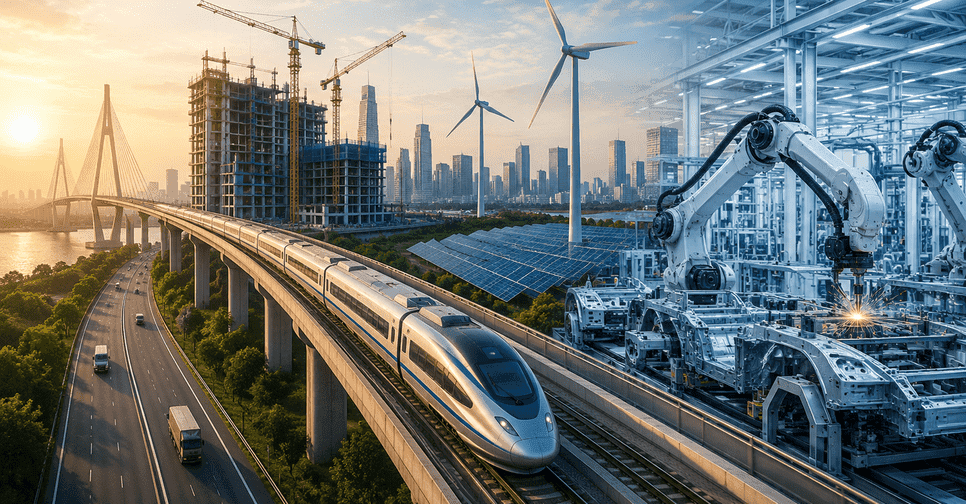
In an era defined by rapid technological advancement and shifting global priorities, the foundations of economic growth are being redefined. No longer driven solely by natural resources or traditional industries, today’s growth is increasingly built upon two strategic pillars: modern infrastructure and advanced manufacturing.
Together, they are shaping a new economic landscape; one where connectivity, resilience, innovation, and efficiency determine competitiveness at both national and global levels.
Rebuilding the Backbone of Global Economies
Infrastructure has always been central to economic development. But in today’s “new economy” its role has expanded far beyond roads, ports, and utilities.
Modern infrastructure is now smart, integrated, and digitally enabled. Governments worldwide are investing heavily in next generation systems, from intelligent transport networks and logistics corridors to energy grids powered by renewable sources and digital connectivity platforms that support data driven economies.
As global trade and supply chains become more complex, countries with efficient, technology driven infrastructure are better positioned to attract investment, facilitate trade, and respond to disruptions. In this context, infrastructure is not just a national asset; it’s a global competitive advantage.
Advanced Manufacturing: The Engine of Industrial Transformation
At the same time, manufacturing is undergoing one of its most profound transformations in history.
It’s powered by automation, artificial intelligence, robotics, additive manufacturing, and digitalization also redefining how goods are produced, distributed, and consumed.
Factories are evolving into smart production ecosystems, where data flows seamlessly across operations, enabling real time decision making, predictive maintenance, and optimized resource use. This shift allows manufacturers to enhance productivity, reduce costs, and improve product quality, while also meeting growing sustainability demands.
Moreover, advanced manufacturing is enabling greater flexibility. Companies can now adapt production processes more quickly, respond to changing market demands, and customize products at scale; capabilities that are essential in today’s dynamic global economy.
The Intersection of Infrastructure and Industry
The true power of these two pillars lies in their intersection.
Advanced manufacturing depends on robust infrastructure, efficient logistics networks, reliable energy systems, and high speed digital connectivity. At the same time, infrastructure development increasingly relies on advanced manufacturing technologies to deliver projects faster, more efficiently, and with greater precision.
This synergy is creating an ecosystem where innovation fuels infrastructure, and infrastructure enables innovation. For investors, this convergence presents significant opportunities. Projects that integrate both physical and digital infrastructure with advanced industrial capabilities are attracting increased capital, particularly in emerging markets where demand for modernization is accelerating.
A Catalyst for Sustainable Growth
Importantly, both infrastructure and advanced manufacturing are at the center of global sustainability efforts. From green buildings and renewable energy systems to energy efficient production processes and circular manufacturing models, these sectors are driving progress toward more sustainable economic models.
Infrastructure is enabling low carbon mobility and clean energy transitions, while advanced manufacturing is reducing waste, improving material efficiency, and lowering emissions. Together, they are helping countries meet climate goals while maintaining economic growth.
This alignment between sustainability and growth is critical. It ensures that future development is not only faster and smarter but also more responsible and resilient.
AIM Congress: Driving the Global Investment Dialogue
In this evolving landscape, AIM Congress stands as the world’s leading investment platform where these critical themes converge.
Infrastructure and advanced manufacturing are central to these discussions, as they represent key drivers of economic diversification, industrial growth, and technological advancement. Through panels, forums, and networking opportunities, AIM Congress facilitates the exchange of insights on how countries and businesses can leverage these sectors to unlock new opportunities for long term impact.
Constructing the Next Chapter of Global Growth
As the global economy continues to evolve, countries that invest in modern infrastructure and advanced manufacturing capabilities will be better equipped to navigate uncertainty, attract capital, and sustain long term growth. The new economy is not just being built; it is being engineered, with precision, technology, and vision.
Be part of the dialogue shaping the future of global investment at AIM Congress.
Connect with leaders. Discover opportunities. Build the foundations of tomorrow.